Prostate Max Review: What's in the Softgel, and What the Research Says
Prostate Max is sold online to men over 50 who are tired of getting up at night. We set the sales video aside and compared its named ingredients with independent research on prostate and urinary symptoms.
Prostate Max reaches most buyers through a long online video that tells an emotional story about a doctor, his father and a "Vicks trick" for the prostate. The video promises a lot: fewer night-time trips, a stronger stream, a smaller prostate and more. Here we do something different. We look at what the product is said to contain and compare it with what independent research actually shows.
How we wrote this review: we have not tested Prostate Max ourselves and did not receive free product. This review is based on the product's sales presentation and the independent health sources linked throughout. We deliberately do not repeat testimonials, celebrity or TV-show references, or the specific results and timelines promised in the video.
What Prostate Max is
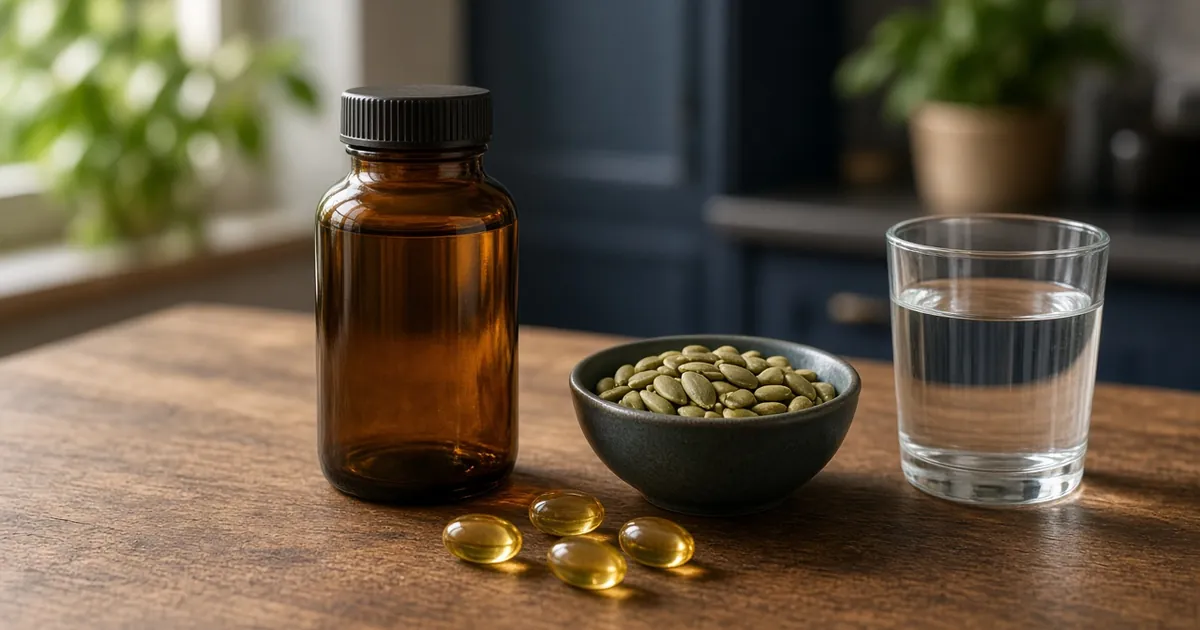
Prostate Max is a dietary supplement sold as softgel capsules. The sales presentation we reviewed names three ingredients: phytosterols from pumpkin seed, grape seed extract and menthol, and says each softgel is protected by a pectin coating. The suggested use is two softgels a day after breakfast.
We could not find a complete, published Supplement Facts panel listing the dose of each ingredient. We also found several unrelated websites using the name "Prostate Max" with different ingredient lists, such as saw palmetto, pygeum and zinc. That is confusing for buyers. Before you pay, read the label shown on the checkout page and make sure it matches what you expect.
The ingredients and the evidence
Pumpkin seed (phytosterols)
Pumpkin seed is the ingredient with the most research behind it. In the GRANU study, about 1,400 men with symptoms of benign prostatic hyperplasia (BPH) took whole pumpkin seed (5 grams twice a day), a pumpkin seed extract capsule, or a placebo for a year. Men taking whole pumpkin seed were somewhat more likely than the placebo group to see a meaningful improvement in their symptom score. The extract capsules did not beat placebo, and neither treatment improved objective measures such as urine flow.
Two things follow. First, the benefit seen was modest. Second, it came from a large daily amount of whole seed, about two tablespoons twice a day. A softgel delivers a far smaller amount of material, usually as an oil or extract, and without published doses we cannot say how Prostate Max compares.
Bottom line on pumpkin seed: the most plausible ingredient in the formula, with modest support for whole seed and no support for the extract tested in the same trial.
Grape seed extract
Grape seed extract contains antioxidant compounds called proanthocyanidins. The National Center for Complementary and Integrative Health (NCCIH) describes research on grape seed extract for blood pressure, circulation and other conditions as limited. We found no human trials of grape seed extract for prostate enlargement or urinary symptoms. It is usually well tolerated but may interact with blood thinners.
Bottom line on grape seed extract: plausible as an antioxidant, unproven for prostate symptoms.
Menthol
Menthol is the cooling compound in peppermint and in mentholated chest rubs, which is where the presentation's "Vicks" story comes from. The NCCIH's page on peppermint oil describes some evidence for peppermint oil in irritable bowel syndrome and for topical use in headaches. We are not aware of any human studies showing that swallowing menthol improves prostate size, urine flow or night-time urination.
Bottom line on menthol: an attention-grabbing ingredient with no prostate evidence we could find.
What about saw palmetto?
Prostate Max's presentation does not list saw palmetto, but many buyers compare it with saw palmetto products. For reference, a large Cochrane review of 32 trials found saw palmetto no better than placebo for urinary symptoms, and the NCCIH agrees that good studies have not shown a benefit. Our guide to prostate supplements compares the main ingredients side by side.
Claims we could not verify
The presentation makes several claims that we could not confirm with independent evidence, including that the formula shrinks the prostate, reverses BPH, balances hormones, works through gut bacteria, or performs better than prescription treatment. Dietary supplements are not allowed to claim they treat or cure disease, and the Federal Trade Commission expects health claims to be backed by competent and reliable scientific evidence. We found no published trials of Prostate Max itself.
Who might consider it
- Men whose urinary symptoms have already been checked by a doctor, who understand the limited evidence, and who want to try a non-prescription option alongside sensible habits.
- Buyers who are comfortable with the price and have read the refund terms.
Who should skip it or ask a doctor first
- Anyone with symptoms that have never been evaluated.
- Men with blood in the urine, pain, fever, sudden worsening or trouble emptying the bladder. These need medical care.
- Anyone taking blood thinners, prostate medications or several other prescriptions, because of possible interactions.
- Men with allergies to any listed ingredient, or with liver or kidney disease.
- Anyone who would stop prescribed treatment to take a supplement. Do not do this without talking to your doctor.
How it is sold
Prostate Max is sold through the seller's online checkout in kits of 2, 3 or 6 bottles. The presentation we reviewed quoted $49 per bottle for the 6-bottle kit and mentioned a 60-day money-back guarantee. Prices and terms are set by the seller and can change. See our page on Prostate Max price and where to buy for a checkout checklist.
Habits that help regardless
Whatever you decide about supplements, these steps are backed by mainstream guidance and cost nothing: taper fluids two to three hours before bed, move caffeine to the morning, go easy on evening alcohol, put your feet up in the evening if your ankles swell, empty your bladder twice before bed and practice pelvic floor exercises. The National Institute on Aging notes that many bladder control problems improve with these kinds of changes. Our guide to night-time urination after 50 covers them in detail.
Our verdict
Frequently asked questions
Does Prostate Max shrink the prostate?
We found no published evidence that Prostate Max, or its named ingredients at typical supplement doses, shrinks the prostate. Prescription 5-alpha reductase inhibitors and medical procedures are the proven ways to reduce prostate size.
What are the ingredients in Prostate Max?
The sales presentation we reviewed names pumpkin seed phytosterols, grape seed extract and menthol in a softgel. We could not find a full Supplement Facts panel with doses, and other websites use the same name for different formulas, so check the label at checkout.
Is Prostate Max safe?
The named ingredients are generally well tolerated in food-like amounts, but supplement quality varies and grape seed extract may interact with blood thinners. Ask your doctor or pharmacist before starting it, especially if you take medications.
How long does Prostate Max take to work?
We cannot say, because there are no published trials of the product. In the pumpkin seed study we cite, men took whole seed daily for a year, and the benefit was modest.
Can I take Prostate Max with my prostate medication?
Check with your doctor or pharmacist first. Do not stop or change prescribed treatment on your own.
Sources
- Prostate Enlargement (Benign Prostatic Hyperplasia) National Institute of Diabetes and Digestive and Kidney Diseases (NIH)
- Benign prostatic hyperplasia (BPH): Symptoms and causes Mayo Clinic
- Vahlensieck W, et al. Effects of pumpkin seed in men with lower urinary tract symptoms due to benign prostatic hyperplasia in the one-year, randomized, placebo-controlled GRANU study. Urol Int. 2015 PubMed
- Tacklind J, et al. Serenoa repens for benign prostatic hyperplasia. Cochrane Database Syst Rev. 2012 PubMed
- Saw Palmetto National Center for Complementary and Integrative Health (NIH)
- Grape Seed Extract National Center for Complementary and Integrative Health (NIH)
- Peppermint Oil National Center for Complementary and Integrative Health (NIH)
- Urinary Incontinence in Older Adults National Institute on Aging (NIH)
- Using Dietary Supplements Wisely National Center for Complementary and Integrative Health (NIH)
- Dietary Supplements U.S. Food and Drug Administration
- Dietary Supplements: What You Need to Know NIH Office of Dietary Supplements
- Health Products Compliance Guidance Federal Trade Commission