Balance and Fall Prevention for Men Over 50
Falls are the leading cause of injury death in older adults, and men often underestimate their risk. Balance is a skill you can train at any age. Here is how to test it, improve it and make your home safer.
Many men think of falls as something that happens to their parents, not to them. But the risk starts climbing well before old age, and men are often more likely to take risks, like climbing ladders, working on roofs or skipping the handrail, and less likely to talk about a near miss.
The CDC reports that falls are the leading cause of injury death for adults 65 and older, causing more than 43,000 deaths and about 4.5 million emergency department visits in 2024. Falls can cause broken hips, head injuries and a loss of confidence that leads to less activity, which in turn raises the risk of future falls.
The good news: the National Institute on Aging explains that many falls can be prevented, and balance is a skill you can improve at any age.
Why balance declines
Staying upright depends on several systems working together:
- Muscles and joints, especially in the legs, hips and core
- Vision, which tells you where you are in space
- The inner ear (vestibular system), which senses head movement
- Nerves in the feet, which sense the ground
- The brain, which processes all this information and reacts
With age, muscle strength and reaction time decline, vision changes, the inner ear becomes less sensitive and nerves in the feet can be affected by conditions like diabetes. Hearing loss is also linked with a higher risk of falls; the NIDCD explains how hearing changes with age.
Common fall risk factors
The CDC and NIA list these common risk factors:
| Risk factor | Why it matters |
|---|---|
| Lower body weakness | Harder to catch yourself or get up |
| Balance or walking problems | Unsteady on uneven ground or stairs |
| Medications | Sedatives, sleep aids, some blood pressure and pain medicines can cause dizziness or drowsiness |
| Vision problems | Harder to see hazards |
| Foot pain or poor footwear | Changes how you walk |
| Home hazards | Clutter, loose rugs, poor lighting, no handrails |
| Low vitamin D | Linked with weaker muscles and bones |
| Alcohol | Affects balance and judgment |
| Dizziness on standing | Often from blood pressure drops |
| Numbness in the feet | Less sense of the ground |
Test your balance
Try these simple checks, standing next to a counter or sturdy chair for safety:
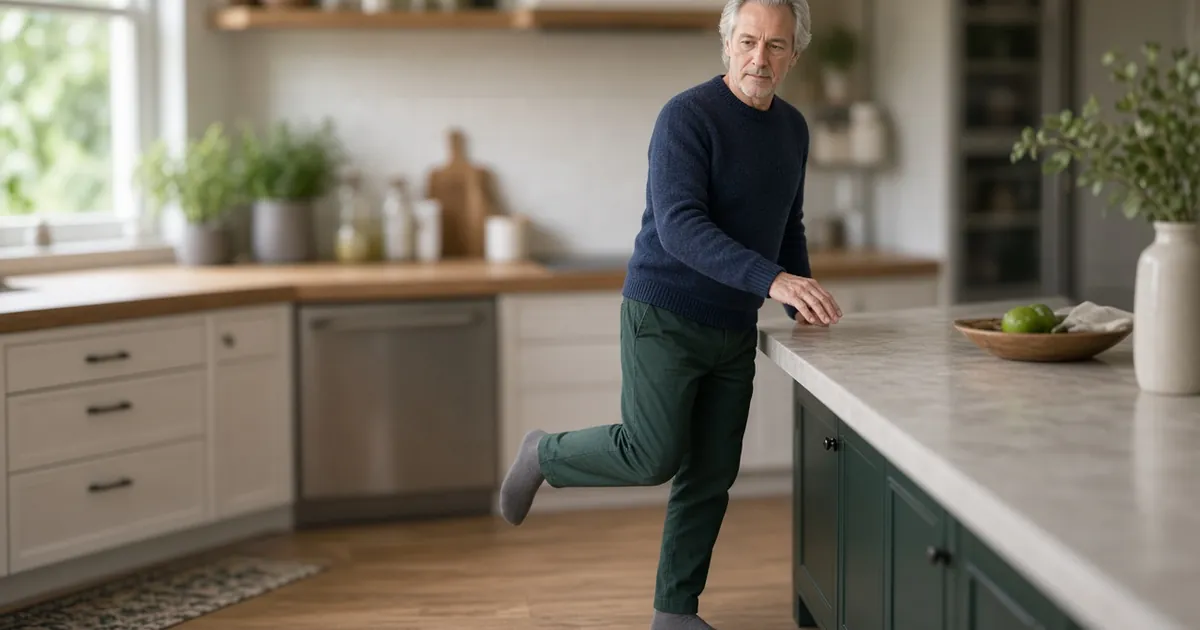
- Single-leg stand: stand on one leg without holding on. Many healthy adults in their 50s and 60s can hold this for 20-30 seconds or more. If you cannot manage 10 seconds, it is a sign to work on balance.
- Tandem stand: stand with one foot directly in front of the other, heel to toe, for 10-30 seconds.
- Chair stand: count how many times you can stand up from a chair without using your arms in 30 seconds. A low count suggests weak legs.
If you struggle with these, or have fallen in the past year, talk to your doctor.
Balance exercises you can do at home
Do these near a counter or sturdy chair. Hold on at first and gradually use less support.
| Exercise | How | Progression |
|---|---|---|
| Single-leg stand | Stand on one leg for 10-30 seconds, switch | Try with eyes closed (with support nearby) |
| Heel-to-toe walk | Walk in a straight line, placing heel directly in front of toes, for 10-20 steps | Turn your head side to side while walking |
| Sit to stand | Stand up and sit down slowly without using hands, 10 times | Hold weights |
| Heel raises | Rise onto your toes and lower slowly, 10-15 times | Do on one leg |
| Side leg raises | Holding a chair, lift one leg out to the side, 10 times each | Add ankle weights |
| Back leg raises | Holding a chair, lift one leg straight back, 10 times each | Add ankle weights |
Aim for balance work at least three days a week. The CDC guidelines for older adults recommend balance activities in addition to aerobic and strength training.
Tai chi
Tai chi is a slow, flowing exercise that research shows can improve balance and reduce falls in older adults. Many community centers offer classes. The National Institute on Aging recommends balance exercises like tai chi for older adults.
Strength training
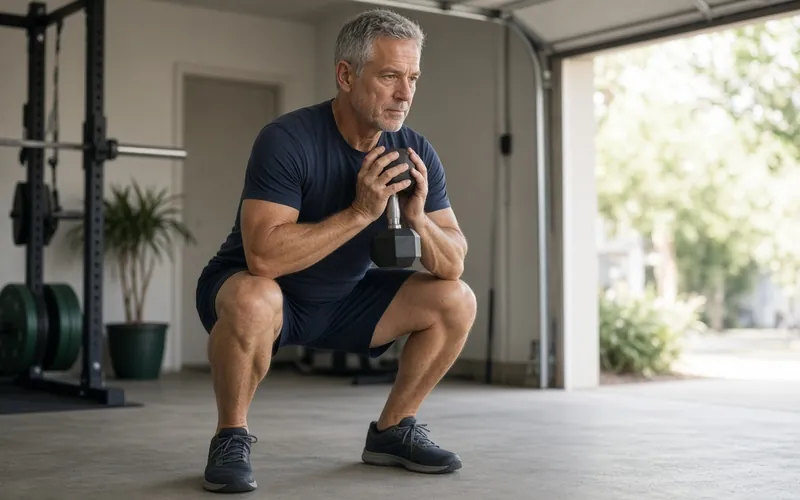
Strong legs and hips are your best defense against falls. Mayo Clinic notes that strength training can improve balance and reduce the risk of falls. See our strength training guide.
Make your home safer
- Clear clutter from walkways and stairs.
- Remove or secure loose rugs with double-sided tape or non-slip backing.
- Improve lighting, especially on stairs, in hallways and between the bedroom and bathroom. Use night lights.
- Install handrails on both sides of stairs and grab bars in the bathroom.
- Use non-slip mats in the shower and bath.
- Keep often-used items within easy reach to avoid step stools.
- Be careful on ladders. Use a stable ladder, have someone hold it, and do not go up alone. Consider hiring help for roofs and gutters.
Other steps
- Review your medications with your doctor or pharmacist at least once a year, especially sleep aids, sedatives, antidepressants and blood pressure medicines.
- Get your eyes checked every year or two, and update glasses.
- Get your hearing checked. See our guide to hearing loss after 50.
- Wear supportive shoes with non-slip soles, both indoors and out. Avoid walking in socks or loose slippers.
- Stand up slowly, especially after lying down or sitting for a long time.
- Limit alcohol. The National Institute on Aging notes that alcohol affects balance and reaction time more as you age.
- Check your vitamin D. The Office of Dietary Supplements explains its role in bone and muscle health.
What to do if you fall
- Stay calm and check for injuries before getting up.
- If you can get up: roll onto your side, get onto your hands and knees, crawl to a sturdy chair, and slowly push yourself up.
- If you cannot get up: call for help, keep warm and change position if you can.
- Keep a phone with you, or consider a medical alert device if you live alone.
- Tell your doctor about any fall, even if you were not hurt.
The bottom line
Balance declines with age but can be trained at any age. Strength and balance exercises, tai chi, a medication review, vision and hearing checks, a safer home, good shoes and less alcohol all reduce the risk of falls. Test your balance, practice daily and talk to your doctor if you feel unsteady.
Frequently asked questions
How can I improve my balance after 50?
Practice balance exercises such as single-leg stands and heel-to-toe walking, strengthen your legs and hips, try tai chi, and stay active. Do balance work at least three days a week.
How long should a 60-year-old be able to stand on one leg?
Many healthy adults in their 60s can stand on one leg for 20-30 seconds or more. If you cannot manage 10 seconds, it is a good idea to work on balance and talk to your doctor.
What medications increase fall risk?
Sedatives, sleep aids, some antidepressants, some blood pressure medicines, opioid pain relievers and antihistamines can cause dizziness or drowsiness. Ask your doctor or pharmacist to review your medications.
Does walking improve balance?
Walking helps leg strength and general fitness, but specific balance and strength exercises are also important for preventing falls.
Sources
- About Older Adult Fall Prevention Centers for Disease Control and Prevention
- Falls and Fractures in Older Adults: Causes and Prevention National Institute on Aging (NIH)
- Older Adult Activity: An Overview Centers for Disease Control and Prevention
- Three Types of Exercise Can Improve Your Health and Physical Ability National Institute on Aging (NIH)
- Strength training: Get stronger, leaner, healthier Mayo Clinic
- Vitamin D: Fact Sheet for Consumers NIH Office of Dietary Supplements
- Facts About Aging and Alcohol National Institute on Aging (NIH)
- Age-Related Hearing Loss (Presbycusis) National Institute on Deafness and Other Communication Disorders (NIH)